
Animation is the rapid display of a sequence of images to create an illusion of movement. The most common method of presenting animation is as a motion picture or video program, although there are other methods. This type of presentation is usually accomplished with a camera and aprojector or a computer viewing screen which can rapidly cycle through images in a sequence. Animation can be made with either hand rendered art, computer generated imagery, or three-dimensional objects, e.g., puppets or clay figures, or a combination of techniques. The position of each object in any particular image relates to the position of that object in the previous and following images so that the objects each appear to fluidly move independently of one another. The viewing device displays these images in rapid succession, usually 24, 25, or 30 frames per second.
History[edit]
Main article: History of animation



Early examples of attempts to capture the phenomenon of motion drawing can be found in paleolithic cave paintings, where animals are depicted with multiple legs in superimposed positions, clearly attempting to convey the perception of motion.
A 5,000 year old earthen bowl found in Iran in Shahr-i Sokhta has five images of a goat painted along the sides. This has been claimed to be an example of early animation. However, since no equipment existed to show the images in motion, such a series of images cannot be called animation in a true sense of the word.[1]
A Chinese zoetrope-type device had been invented in 180 AD.[2] The phenakistoscope, praxinoscope, and the common flip book were early popular animation devices invented during the 19th century.
These devices produced the appearance of movement from sequential drawings using technological means, but animation did not really develop much further until the advent of cinematography. The cinématographe was a projector, printer, and camera in one machine that allowed moving pictures to be shown successfully on a screen which was invented by history's earliest film makers, Auguste and Louis Lumière, in 1894.[3]
There is no single person who can be considered the "creator" of film animation, as there were several people working at about the same time on projects which could be considered animation.
Georges Méliès was a creator of special-effect films and was generally regarded as one of the first people to use animation. He discovered the technique by accident when stopping his camera from rolling in order to change something in the scene, and then continuing rolling the film. This idea was later known as stop-motion animation. Méliès' camera broke down while shooting a bus driving by. When he had fixed the camera, a hearse happened to be passing by just as Méliès restarted rolling the film; his end result was that he had managed to make a bus transform into a hearse. He was just one of the great contributors to the development of animation in the early years.
The earliest surviving stop-motion advertising film was an English short by Arthur Melbourne-Cooper called Matches: An Appeal (1899). Developed for the Bryant and May Matchsticks company, it involved stop-motion animation of wired-together matches writing a patriotic call to action on a blackboard.
J. Stuart Blackton was possibly the first American film-maker to use the techniques of stop-motion and hand-drawn animation. Introduced to film-making by Edison, he pioneered these concepts at the turn of the 20th century with his first copyrighted work, dated 1900. Several of his films, among them The Enchanted Drawing (1900) and Humorous Phases of Funny Faces (1906) were film versions of Blackton's "lightning artist" routine, and utilized modified versions of Méliès' early stop-motion techniques to make a series ofblackboard drawings appear to move and reshape themselves. Humorous Phases of Funny Faces is regularly cited as the first true animated film, and Blackton is considered the first trueanimator.
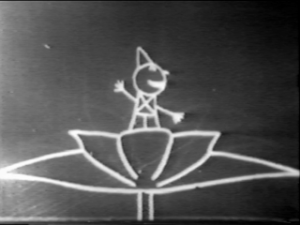
Another French artist, Émile Cohl, began drawing cartoon strips and created a film in 1908 called Fantasmagorie. The film largely consisted of a stick figure moving about and encountering all manner of morphing objects, such as a wine bottle that transforms into a flower. There were also sections of live action where the animator’s hands would enter the scene. The film was created by drawing each frame on paper and then shooting each frame onto negative film, which gave the picture a blackboard look. This makes Fantasmagorie the first animated film created by using what came to be known as traditional (hand-drawn) animation.
The author of the first puppet-animated film (The Beautiful Lukanida (1912)) was the Russian-born (ethnically Polish) director Wladyslaw Starewicz, known as Ladislas Starevich.[citation needed]
Following the successes of Blackton and Cohl, many other artists began experimenting with animation. One such was Winsor McCay, a successful newspaper cartoonist who created detailed animations that required a team of artists and painstaking attention to detail. Each frame was drawn on paper, which invariably required backgrounds and characters to be redrawn and animated. Among McCay's most noted films are Little Nemo (1911), Gertie the Dinosaur (1914) and The Sinking of the Lusitania (1918).
The production of animated short films, typically referred to as "cartoons", became an industry of its own during the 1910s, and cartoon shorts were produced for showing in movie theaters. The most successful early animation producer was John Randolph Bray, who, along with animator Earl Hurd, patented the cel animation process which dominated the animation industry for the rest of the decade.
El Apóstol (Spanish: "The Apostle") was a 1917 Argentine animated film utilizing cutout animation, and the world's first animated feature film.[4] Unfortunately, a fire that destroyed producer Frederico Valle's film studio incinerated the only known copy of El Apóstol, and it is now considered a lost film.
Computer animation has become popular since Toy Story (1995), the first animated film completely made using this technique.
In 2008, the animation market was worth US$68.4 billion.[5]
Techniques[edit]
Traditional animation[edit]
Main article: Traditional animation
Traditional animation (also called cel animation or hand-drawn animation) was the process used for most animated films of the 20th century. The individual frames of a traditionally animated film are photographs of drawings that are first drawn on paper. To create the illusion of movement, each drawing differs slightly from the one before it. The animators' drawings are traced or photocopied onto transparent acetate sheets called cels, which are filled in with paints in assigned colors or tones on the side opposite the line drawings. The completed character cels are photographed one-by-one against a painted background by a rostrum camera onto motion picture film .
The traditional cel animation process became obsolete by the beginning of the 21st century. Today, animators' drawings and the backgrounds are either scanned into or drawn directly into a computer system. Various software programs are used to color the drawings and simulate camera movement and effects. The final animated piece is output to one of several delivery media, including traditional 35 mm film and newer media such as digital video. The "look" of traditional cel animation is still preserved, and the character animators' work has remained essentially the same over the past 70 years. Some animation producers have used the term "tradigital" to describe cel animation which makes extensive use of computer technology.
Examples of traditionally animated feature films include Pinocchio (United States, 1940), Animal Farm (United Kingdom, 1954), Akira (Japan, 1988), and L'Illusionniste (British-French, 2010). Traditional animated films which were produced with the aid of computer technology include The Lion King (US, 1994) Sen to Chihiro no Kamikakushi (Spirited Away) (Japan, 2001), Les Triplettes de Belleville (France, 2003), and The Secret of Kells (Irish-French-Belgian, 2009).

- Full animation refers to the process of producing high-quality traditionally animated films that regularly use detailed drawings and plausible movement. Fully animated films can be made in a variety of styles, from more realistically animated works such as those produced by the Walt Disney studio (Beauty and the Beast, Aladdin, Lion King) to the more 'cartoon' styles of the Warner Bros. animation studio. Many of the Disney animated features are examples of full animation, as are non-Disney works such as The Secret of NIMH (US, 1982), The Iron Giant (US, 1999), and Nocturna (Spain, 2007).
- Limited animation involves the use of less detailed and/or more stylized drawings and methods of movement. Pioneered by the artists at the American studio United Productions of America, limited animation can be used as a method of stylized artistic expression, as in Gerald McBoing Boing (US, 1951), Yellow Submarine (UK, 1968), and much of the anime produced in Japan. Its primary use, however, has been in producing cost-effective animated content for media such as television (the work of Hanna-Barbera, Filmation, and other TV animation studios) and later the Internet (web cartoons).
- Rotoscoping is a technique patented by Max Fleischer in 1917 where animators trace live-action movement, frame by frame. The source film can be directly copied from actors' outlines into animated drawings, as in The Lord of the Rings (US, 1978), or used in a stylized and expressive manner, as in Waking Life (US, 2001) and A Scanner Darkly (US, 2006). Some other examples are: Fire and Ice (USA, 1983) and Heavy Metal(1981).
- Live-action/animation is a technique combining hand-drawn characters into live action shots. One of the earlier uses was in Koko the Clownwhen Koko was drawn over live action footage. Other examples include Who Framed Roger Rabbit (USA, 1988), Space Jam (USA, 1996) and Osmosis Jones (USA, 2001).
Stop motion animation[edit]
Main article: Stop motion
Stop-motion animation is used to describe animation created by physically manipulating real-world objects and photographing them one frame of film at a time to create the illusion of movement. There are many different types of stop-motion animation, usually named after the medium used to create the animation. Computer software is widely available to create this type of animation; however, traditional stop motion animation is usually less expensive and time-consuming to produce than current computer animation.
- Puppet animation typically involves stop-motion puppet figures interacting in a constructed environment, in contrast to real-world interaction in model animation. The puppets generally have an armature inside of them to keep them still and steady as well as to constrain their motion to particular joints. Examples include The Tale of the Fox (France, 1937), The Nightmare Before Christmas (US, 1993), Corpse Bride (US, 2005), Coraline (US, 2009), the films of Jiří Trnka and the TV series Robot Chicken (US, 2005–present).
- Puppetoon, created using techniques developed by George Pal, are puppet-animated films which typically use a different version of a puppet for different frames, rather than simply manipulating one existing puppet.
- Puppetoon, created using techniques developed by George Pal, are puppet-animated films which typically use a different version of a puppet for different frames, rather than simply manipulating one existing puppet.
- Clay animation, or Plasticine animation (often called claymation, which, however, is a trademarked name), uses figures made of clay or a similar malleable material to create stop-motion animation. The figures may have an armature or wire frame inside, similar to the related puppet animation (below), that can be manipulated to pose the figures. Alternatively, the figures may be made entirely of clay, such as in the films ofBruce Bickford, where clay creatures morph into a variety of different shapes. Examples of clay-animated works include The Gumby Show (US, 1957–1967) Morph shorts (UK, 1977–2000), Wallace and Gromit shorts (UK, as of 1989), Jan Švankmajer's Dimensions of Dialogue(Czechoslovakia, 1982), The Trap Door (UK, 1984). Films include Wallace & Gromit: The Curse of the Were-Rabbit, Chicken Run and The Adventures of Mark Twain.
- Cutout animation is a type of stop-motion animation produced by moving two-dimensional pieces of material such as paper or cloth. Examples include Terry Gilliam's animated sequences from Monty Python's Flying Circus (UK, 1969–1974); Fantastic Planet(France/Czechoslovakia, 1973) ; Tale of Tales (Russia, 1979), The pilot episode of the TV series (and sometimes in episodes) of South Park(US, 1997).
- Silhouette animation is a variant of cutout animation in which the characters are backlit and only visible as silhouettes. Examples include The Adventures of Prince Achmed (Weimar Republic, 1926) and Princes et princesses (France, 2000).
- Model animation refers to stop-motion animation created to interact with and exist as a part of a live-action world. Intercutting, matte effects, and split screens are often employed to blend stop-motion characters or objects with live actors and settings. Examples include the work of Ray Harryhausen, as seen in films such Jason and the Argonauts (1963), and the work of Willis O'Brien on films such as King Kong (1933 film).
- Go motion is a variant of model animation which uses various techniques to create motion blur between frames of film, which is not present in traditional stop-motion. The technique was invented by Industrial Light & Magic and Phil Tippett to create special effects scenes for the film The Empire Strikes Back (1980). Another example is the dragon named "Vermithrax" from Dragonslayer (1981 film).
- Object animation refers to the use of regular inanimate objects in stop-motion animation, as opposed to specially created items.
- Graphic animation uses non-drawn flat visual graphic material (photographs, newspaper clippings, magazines, etc.) which are sometimes manipulated frame-by-frame to create movement. At other times, the graphics remain stationary, while the stop-motion camera is moved to create on-screen action.
- Brickfilm A sub-genre of object animation involving using Lego or other similar brick toys to make an animation. These have had a recent boost in popularity with the advent of video sharing sites like YouTube and the availability of cheap cameras and animation software.
- Pixilation involves the use of live humans as stop motion characters. This allows for a number of surreal effects, including disappearances and reappearances, allowing people to appear to slide across the ground, and other such effects. Examples of pixilation include The Secret Adventures of Tom Thumb and Angry Kid shorts.


Computer animation[edit]
Main article: Computer animation
Computer animation encompasses a variety of techniques, the unifying factor being that the animation is created digitally on a computer. This animation takes less time to produce than previous traditional animation. 2D animation techniques tend to focus on image manipulation while 3D techniques usually build virtual worlds in which characters and objects move and interact. 3D animation can create images that seem real to the viewer.
2D animation[edit]
2D animation figures are created and/or edited on the computer using 2D bitmap graphics or created and edited using 2D vector graphics. This includes automated computerized versions of traditional animation techniques such as interpolated morphing, onion skinning and interpolated rotoscoping.
2D animation has many applications, including analog computer animation, Flash animation and PowerPoint animation. Cinemagraphs are still photographs in the form of an animated GIF file of which part is animated.
2D Terms[edit]
- Final line advection animation,[6] a technique that gives the artists and animators a lot more influence and control over the final product as everything is done within the same department:In Paperman, we didn’t have a cloth department and we didn’t have a hair department. Here, folds in the fabric, hair silhouettes and the like come from of the commited design decision-making that comes with the 2D drawn process. Our animators can change things, actually erase away the CG underlayer if they want, and change the profile of the arm. And they can design all the fabric in that Milt Kahl kind-of way, if they want to.[7]
3D animation[edit]
Main articles: Computer animation and 3D computer graphics
3D animation is digitally modeled and manipulated by an animator. The animator starts by creating an external 3D mesh to manipulate. A mesh is a geometric configuration that gives the visual appearance of form to a 3D object or 3D environment. The mesh may have many vertices which are the geometric points which make up the mesh; it is given an internal digital skeletal structure called an armature that can be used to control the mesh with weights. This process is called rigging and can be programmed for movement with keyframes.
Other techniques can be applied, such as mathematical functions (e.g., gravity, particle simulations), simulated fur or hair, and effects such as fire and water simulations. These techniques fall under the category of 3D dynamics.
3D Terms[edit]
- Cel-shaded animation is used to mimic traditional animation using CG software. Shading looks stark, with less blending of colors. Examples include, Skyland (2007, France), Appleseed Ex Machina (2007, Japan), The Legend of Zelda: Wind Waker (2002, Japan)
- Machinima – Films created by screen capturing in video games and virtual worlds.
- Motion capture is used when live-action actors wear special suits that allow computers to copy their movements into CG characters. Examples include Polar Express (2004, USA), Beowulf(2007, USA), A Christmas Carol (2009, USA), The Adventures of Tintin (2011, USA)
- Photo-realistic animation is used primarily for animation that attempts to resemble real life, using advanced rendering that mimics in detail skin, plants, water, fire, clouds, etc. Examples include Up (2009, USA), Kung-Fu Panda (2008, USA), Ice Age (2002, USA).
Mechanical animation[edit]
- Animatronics is the use of mechatronics to create machines which seem animate rather than robotic.
- Audio-Animatronics is a form of robotics animation created by Walt Disney Imagineering for shows and attractions at Disney theme parks move and make noise (generally a recorded speech or song), but are fixed to whatever supports them. They can sit and stand but cannot walk. An Audio-Animatron is different from an android-type robot in that it uses prerecorded movements and sounds, rather than responding to external stimuli. In 2009, Disney created an interactive version of the technology called Autonomatronics.
- Chuckimation is a type of animation created by the makers of the cartoon Action League Now! in which characters/props are thrown, or chucked from off camera or wiggled around to simulate talking by unseen hands,
- Puppetry is a form of theatre or performance animation that involves the manipulation of puppets. It is very ancient, and is believed to have originated 3000 years BC.[1] Puppetry takes many forms but they all share the process of animating inanimate performing objects. Puppetry is used in almost all human societies both as entertainment – in performance – and ceremonially in rituals and celebrations such as carnivals. Most puppetry involves storytelling.
- Zoetrope is a device that produces the illusion of motion from a rapid succession of static pictures. The term zoetrope is from the Greek words ζωή (zoē), meaning "alive, active", and τρόπος (tropos), meaning "turn", with "zoetrope" taken to mean "active turn" or "wheel of life".
Other animation techniques[edit]
- Drawn on film animation: a technique where footage is produced by creating the images directly on film stock, for example by Norman McLaren, Len Lye and Stan Brakhage.
- Paint-on-glass animation: a technique for making animated films by manipulating slow drying oil paints on sheets of glass, for example by Aleksandr Petrov.
- Erasure animation: a technique using tradition 2D medium, photographed over time as the artist manipulates the image. For example, William Kentridge is famous for his charcoal erasure films, and Piotr Dumała for his auteur technique of animating scratches on plaster.
- Pinscreen animation: makes use of a screen filled with movable pins which can be moved in or out by pressing an object onto the screen. The screen is lit from the side so that the pins cast shadows. The technique has been used to create animated films with a range of textural effects difficult to achieve with traditional cel animation.
- Sand animation: sand is moved around on a back- or front-lighted piece of glass to create each frame for an animated film. This creates an interesting effect when animated because of thelight contrast.
- Flip book: a flip book (sometimes, especially in British English, called a flick book) is a book with a series of pictures that vary gradually from one page to the next, so that when the pages are turned rapidly, the pictures appear to animate by simulating motion or some other change. Flip books are often illustrated books for children, but may also be geared towards adults and employ a series of photographs rather than drawings. Flip books are not always separate books, but may appear as an added feature in ordinary books or magazines, often in the page corners. Software packages and websites are also available that convert digital video files into custom-made flip books.
Other styles, techniques and approaches[edit]
- Animutation - a style of animation invented by Neil Cicierega at age 13. This style of animation is usually characterized by random images of pop culture in sequence with foreign music. The animation style is strange, weird, random, but from a creator's point of view, very easy to implement. Professionalism is not required in the Animutation style.[citation needed]
- Character animation
- Multi-sketching
- Special effects animation
Awards[edit]
As with any other form of media, animation too has instituted awards for excellence in the field. The original awards for animation were presented by the Academy of Motion Picture Arts and Sciences for animated shorts from the year 1932, during the 5th Academy Awards function. The first winner of the Academy Award was the short Flowers and Trees, a production by Walt Disney Productions and United Artists.[8] However, the Academy Award for a feature length animated motion picture was only instituted for the year 2001, and awarded during the 74th Academy Awards in 2002. It was won by the movie Shrek,[9] produced by DreamWorks and Pacific Data Images. Since then, Disney/Pixar have produced the most movies either to win or be nominated for the award. The list of both awards can be obtained here:
- Academy Award for Best Animated Feature
- Academy Award for Best Animated Short Film
Several other countries have instituted an award for best animated feature film as part of their national film awards: BAFTA Award for Best Animated Film (since 2006), César Award for Best Animated Film (since 2011), Goya Award for Best Animated Film (since 1989), Japan Academy Prize for Animation of the Year (since 2007). Also since 2007, the Asia Pacific Screen Award for Best Animated Feature Film has been awarded at the Asia Pacific Screen Awards. Since 2009, the European Film Awards have awarded the European Film Award for Best Animated Film.
The Annie Award is another award presented for excellence in the field of animation. Unlike the Academy Awards, the Annie Awards are only received for achievements in the field of animation and not for any other field of technical and artistic endeavor. They were re-organized in 1992 to create a new field for Best Animated feature. The 1990s winners were dominated by Walt Disney, however newer studios, led by Pixar, have now begun to consistently vie for this award. The list of awardees is as follows:


